If you’ve ever operated construction equipment, agricultural machinery, or industrial handling systems, you’ve probably used a quick coupler without realizing it. These small but critical components turn a excavator into a digger, a loader into a pallet mover, or a crane into a material lifter in seconds—no tools required. But there’s one spec that’s non-negotiable for both safe operation and long coupler lifespan: the opening force of the quick coupler. As someone who’s spent 12 years as a quick coupler supplier, I’ve seen firsthand how miscalculating this number leads to everything from minor delays to dangerous accidents. Let’s break it down like I’d explain it to a new equipment operator on a jobsite. Quick Coupler
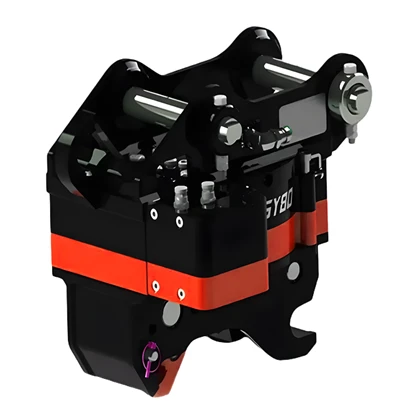
First, let’s define opening force plainly, not with textbook jargon. When a quick coupler is closed around an attachment’s pin, it doesn’t just click into place and lock. You need a specific amount of force to pull the two halves of the coupler apart when you want to swap attachments. That force is the opening force, measured in Newtons (N) or pounds-force (lbf), and it’s generated either by the machine’s hydraulic system, a spring-loaded mechanism, or a manual lever, depending on the coupler type.
Here’s where the confusion starts: a lot of suppliers advertise maximum breaking force or closing force as the same number, and operators mix them up every day. Closing force is how hard the coupler presses onto the attachment pin to hold it in place during operation. If a bucket is digging into rock, the pin pushes back on the coupler; the closing force is how well the coupler resists slipping or releasing. Opening force is the opposite: it’s the force required to overcome that held position, to unlock and separate the coupler from the pin. Get this wrong, and two bad things happen: either you can’t swap attachments when you need to, stopping your entire jobsite, or you need more force than your machine’s hydraulics can provide, risking damage to the coupler, the attachment, or even the machine’s arm.
Now, let’s talk about how opening force is calculated, because it’s not a one-size-fits-all number. There are two key variables that every supplier and operator must account for: the type of coupler, and the attachment it’s paired with.
Coupler types vary wildly. The most common are manual quick couplers, hydraulic quick couplers, and “pin grabber” couplers (the kind that clamp around two pins instead of one). Manual couplers, which are still used on smaller compact excavators or farm tractors, have spring-driven opening mechanisms. Their opening force is lower, usually between 150 lbf and 400 lbf, because a worker can manually overcome that force without extra tools. But here’s the catch: as coupler size goes up for mid-sized excavators (10 to 20 tons), even manual couplers start needing more force, and you can’t assume a manual model’s opening force works for a 15-ton machine. Hydraulic quick couplers, by far the most popular on large construction sites, use the machine’s own hydraulic lines to actuate the lock. Their opening force is dependent on the machine’s hydraulic pressure output. For example, a 20-ton excavator typically has a hydraulic pressure of 3,000 psi (pounds per square inch), which translates to an opening force of 1,200 lbf to 1,800 lbf. If a supplier rates a hydraulic coupler for that machine but doesn’t account for its specific hydraulic pressure, the coupler will either be too tight to open or too loose to hold the attachment.
The second variable is the attachment itself. Every attachment has pin sizes, pin spacing, and weight that change the opening force required. A small digging bucket for a compact excavator has a single 1.5-inch pin, so the opening force for a coupler paired with that bucket is lower. But a heavy-duty rock breaker for a 25-ton excavator has two 2-inch pins, and the stress from the breaker’s operation puts extra pressure on the coupler’s lock. That extra stress increases the opening force needed to unlock the coupler when you want to swap the breaker for a grapple. We’ve had customers come to us before, frustrated, because they bought a coupler online that worked fine with their 1-cubic-yard bucket, but when they tried to use it with a 5,000-lb pile driver, they couldn’t open the coupler at the end of the day—because the pin had expanded slightly under constant stress, increasing the friction between the pin and coupler walls. Friction is often the biggest hidden factor in opening force, not the coupler’s own design. That’s why we test every coupler in our warehouse before shipping: we simulate the stress of a 10-hour workday on a test bench, measuring friction to make sure the opening force is exactly calibrated for the machine and attachment it’s meant for.
Now, let’s talk about why opening force matters beyond just convenience. I’ve seen three serious incidents in my career that all traced back to incorrect opening force. The first was a 2019 jobsite in suburban Chicago: an operator was swapping a bucket for a hydraulic hammer on a 12-ton excavator. He’d bought a cheap coupler from a third-party seller, and the opening force was rated too high for his machine’s hydraulic system. He pushed the hydraulic lever as far as it would go, strained the coupler’s lock mechanism, and the hammer dropped 10 feet into a residential lawn, missing a family’s car by 2 feet. The second incident, on a farm in Iowa, involved a manual coupler on a tractor. The operator didn’t account for the fact that the plow he was using had a rusted pin, which increased friction. He tried to open the coupler with a crowbar, slipped, and broke his wrist. The third was a crane operator in Houston: a quick coupler for a lifting magnet had an opening force that was too low, so the magnet slipped off the coupler while lifting 10,000 lbs of steel, damaging two parked semi-trucks. All of these could have been avoided with a properly calibrated opening force for the specific machine and attachment.
So, how do you make sure you’re getting the right opening force for your application? As a supplier, here’s the guidance I give every customer who calls or emails: first, share your machine’s make, model, and year—every brand (John Deere, Caterpillar, Kubota, JCB) has slightly different hydraulic pressure specs, even for machines of the same weight class. Second, share the attachment’s specs: pin diameter, pin spacing, and the maximum weight of the attachment it will be paired with. Third, tell us the jobsite conditions—if you’re working in a coastal area with saltwater, that pin will corrode faster, increasing friction, so we build in a 10% buffer to the opening force to account for extra wear.
I know some customers price shop first, and cheap couplers often cut corners on opening force calibration. A supplier might use a one-size-fits-all spring for every 15-ton coupler, not testing for the specific machine’s hydraulics. That’s why when customers ask for a quote, I always include a breakdown of the opening force calculation: “For your 16-ton JCB excavator, hydraulic pressure is 2,800 psi, opening force is 1,500 lbf, calibrated for your 2-inch pin rock bucket.” No fine print, no hidden numbers.
We also stand by our calibration because we test every coupler in-house, not outsource testing. We have a 10,000 lbf test bench that simulates 5,000 cycles of opening and closing, which is the equivalent of a year of regular use. If a coupler’s opening force deviates more than 5% from our calibrated spec, we scrap it and rework it—no exceptions. We do this because I learned early in my career that reputation is built on keeping operators safe, not on cutting costs.
Another common question I get: can you adjust the opening force later if you change machines or attachments? Sometimes, but not always. For hydraulic couplers, you can adjust the relief valve on the machine’s hydraulic system slightly, but that’s a risky fix—adjusting it too high can cause hydraulic damage to the machine, and too low means you’ll still struggle to open the coupler. For manual couplers, you can swap out springs, but that requires disassembling the coupler, which most operators can’t do on a jobsite with basic tools. That’s why it’s always better to get the right opening force upfront, not try to fix a bad fit later.
At the end of the day, quick couplers are the unsung heroes of the equipment industry. They’re the reason a jobsite can swap a digger, a lifter, a breaker, and a pallet mover in minutes instead of hours. But their opening force is the single most important spec to get right, because it’s the line between convenience and danger.

If you’re an operator, fleet manager, or farm owner who’s ever struggled to swap an attachment, or worried that your coupler isn’t safe, we can help. Let’s talk through your specific machine and attachments, so we can recommend the right quick coupler with an opening force calibrated just for you. No generic numbers, no hidden jargon, just a spec that works for your jobsite.
Bucket Reference:
- Society of Manufacturing Engineers. (2021). Hydraulic Quick Coupler Design and Calibration for Mobile Equipment. SME Press.
- Occupational Safety and Health Administration (OSHA). (2019). Standard 1926.602: Material Handling Equipment, Section (c)(3) – Attachment Coupling Safety. U.S. Department of Labor.
- International Organization for Standardization (ISO). (2020). ISO 13029: Earth-moving Machinery – Quick Couplers for Work Tools – General Requirements and Tests. ISO.
Yantai Donghong Construction Machinery Co., Ltd.
As one of the most experienced quick coupler manufacturers and suppliers in China, our products have good reputation in the market. Please feel free to buy customized quick coupler at competitive price from our factory. Good service and quality products are available.
Address: No.10, 8-2, Beijing South Road, Yantai Economic & Technological Development Area, Shandong, China.
E-mail: dhgmachinery@donghongjixie.com
WebSite: https://www.dhgattachment.com/
